
Language models
DeepSeek V4.1 Flash 1017: API Names and Migration Checks
DeepSeek’s new Flash release is live, and older official aliases now resolve to it. Check model names, gateway capabilities and task-level results before changing a production workflow.
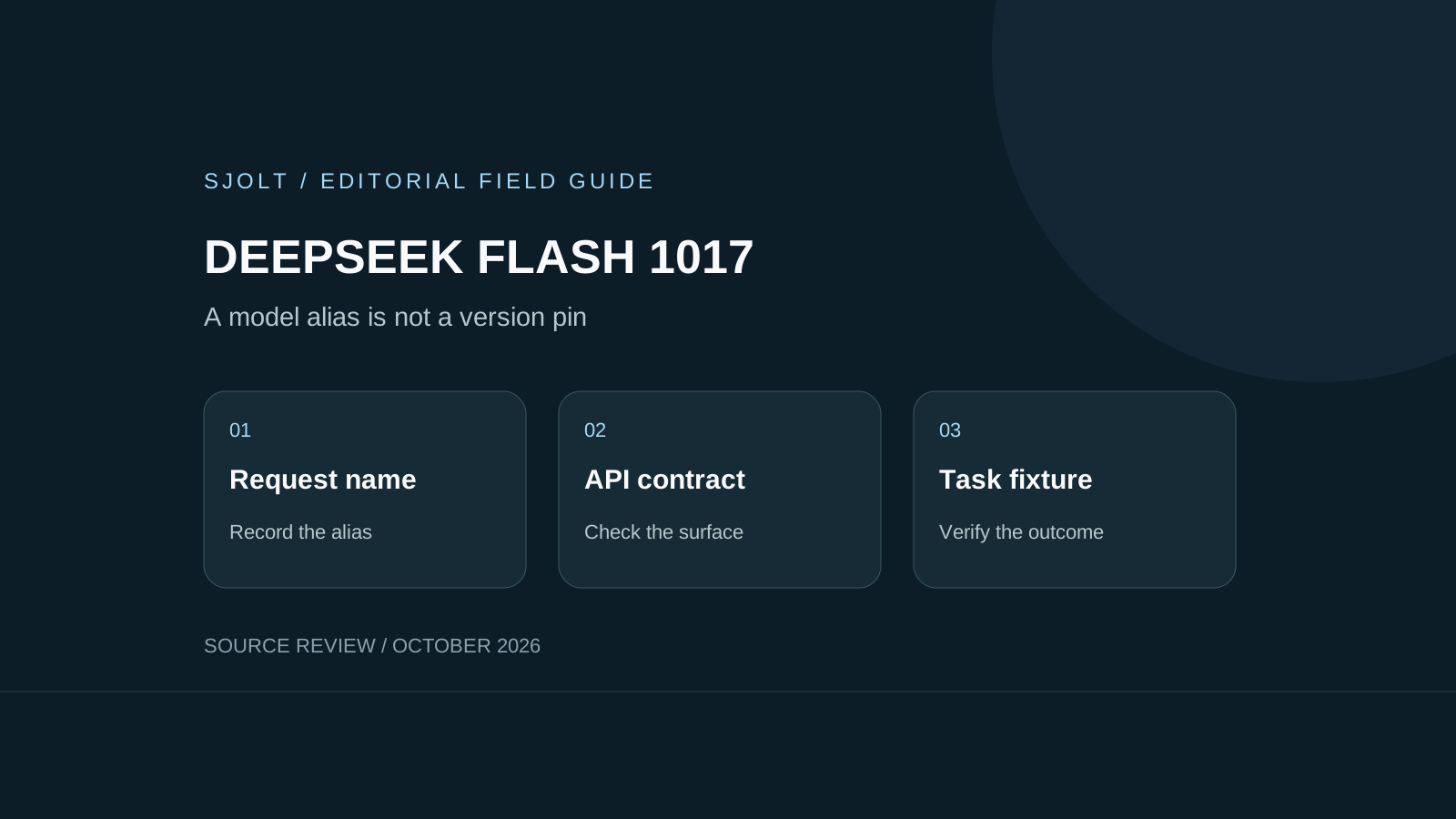
DeepSeek-V4.1-Flash-1017 is an official October 17, 2026 update. DeepSeek says it is live on its website, app and API. The recommended direct API model name is deepseek-flash; 1017 is part of the release identity, not a reason to invent a new endpoint path.
The migration detail matters: DeepSeek’s documentation says legacy deepseek-v4-flash and deepseek-v4-flash-vision-exp names are still accepted but now served by 1017. An unchanged request name can therefore produce behavior from a newer model. Record both the requested alias and the provider’s dated version mapping.
What changed, and what still needs your own test
The announcement emphasizes stronger project-development performance with shorter outputs and faster completion. It recommends DeepSeek Harness v0.2.1-rc.1 or later for the new model. Those are publisher claims and integration guidance, not an independent finding that every agent task is now cheaper or more accurate.
The official model card describes a minor V4.1 Flash update and identifies the harnesses used for reported benchmarks. Local inference has a separate setup: the card supplies a reference prompt encoder rather than a Jinja chat template. Its deepseek-recipe toolkit handles protocol conversion and output parsing, while inference, tool execution and HTTP transport remain the caller’s responsibility.
For a hosted API client, a model upgrade does not mean you need to reproduce local weight loading. For a self-hosted evaluation, protocol compatibility requires more than loading the tokenizer. Choose the deployment path first and keep its dependencies in the evaluation record.
Keep provider names and gateway names distinct
| Surface | Name or boundary | What to verify |
|---|---|---|
| DeepSeek direct API | deepseek-flash | Official documentation maps it to 1017. |
| DeepSeek legacy aliases | deepseek-v4-flash and deepseek-v4-flash-vision-exp | Accepted names now remap; they are not old-version pins. |
| SJolt catalog | deepseek/deepseek-v4-flash | Current public model name remains DeepSeek V4 Flash. |
| SJolt capabilities | Text input in the current catalog | Do not assume newly documented direct-provider features are enabled. |
SJolt’s configuration still uses the older official Flash alias and retains older version metadata. Read together with DeepSeek’s remapping notice, that suggests the upstream alias can resolve to 1017; it does not establish a tested, explicitly versioned 1017 integration. No live SJolt request was made for this guide. In particular, do not infer image input or standalone Search/Fetch access from the provider announcement.
Treat this as a contract review item for an existing application. Confirm the supported input type, API format, thinking settings and billing behavior at the surface you actually call. A provider’s updated feature matrix cannot by itself widen a gateway’s validation rules.
A direct-provider request shape
DeepSeek’s quickstart uses the Chat Completions endpoint with bearer authentication and a messages array. This example asks for a text-only review plan and disables streaming. It is a billable request if run with your own key. It was checked for syntax, not executed against the model.
curl --fail-with-body 'https://api.deepseek.com/chat/completions' \
  -H "Authorization: Bearer $DEEPSEEK_API_KEY" \
  -H 'Content-Type: application/json' \
  --data '{
    "model": "deepseek-flash",
    "messages": [
      {"role": "system", "content": "Return a concise review plan. Preserve stated constraints and flag missing facts."},
      {"role": "user", "content": "Plan checks for a media task ledger. A pending task must not create an empty image file or trigger a duplicate submission."}
    ],
    "stream": false
}'Keep the credential in the service environment and attach the response to a specific evaluation case. For a migration test, save completion status and usage as well as text. A shorter answer is useful only if it still contains the required checks; do not grade concision independently of completeness.
Test the agent loop with an offline fixture first
Use a small media-task ledger as a practical coding exercise. Supply invented task records with pending, successful and failed states. Ask the agent to implement state transitions and a review queue without making network requests. That isolates code and tool behavior from the cost and variability of generating actual images.
- Repeat a successful task event and require one accepted ledger entry.
- Include a failed download after generation succeeds; preserve the task ID for recovery.
- Change the brief revision while an earlier attempt is pending; keep both histories distinct.
- Pass a malformed tool result and require a visible error instead of an invented output URL.
Run the same fixtures before and after a migration with the same tool permissions and time limit. Check the produced code, executed commands and final files. Record elapsed time, review time and total usage across the loop. A single token count or provider benchmark cannot reveal whether a changed model introduced an extra retry or skipped a required validation.
If a result fails, classify the failure: wrong plan, tool argument, state handling, output parsing or review omission. Fix the smallest reproducible case before widening the rollout. Keep a known working configuration available, while remembering that an old alias is not necessarily a way to recover old weights.
Distinguish model billing from search tools
DeepSeek now documents standalone Search and Fetch APIs at $0.75 per 1,000 successful requests each. The temporary free period mentioned for server-side tools in supported agent integrations ends October 31 at 16:00 UTC, which is November 1 at 00:00 Beijing time. That statement is not a promise that all direct Search/Fetch calls are currently free.
Keep model tokens, search calls and media generation in separate usage records. Compare complete accepted tasks under the same conditions, and read current peak/off-peak rates before estimating a real batch. No price from the direct DeepSeek service should be presented as an SJolt account quote.
Connect the tested planner to an image workflow
After the fixture passes, a supported SJolt image route such as Nano Banana 2.1 can supply assets separately. Use the language model to organize approved requirements, then have your application submit and track the documented image task. The language response itself is not a generated image or a confirmation that a paid request succeeded.
Retain the brief revision, media task ID, returned file and human acceptance decision. This keeps a language-model migration from silently changing which artwork is delivered. No inference, model installation or paid image generation was performed for this guide.
Sources & further reading
Take the next idea into production.
Explore the models, test a workflow in the playground, and use the same request in your application.