
Industry analysis
China AI Bubble: What the Stock Sell-Off Means for AI Buyers
China AI bubble headlines concern market valuations. Read the underlying measure, then use a small delivery-cost and continuity review to decide what changes in your AI workflow.
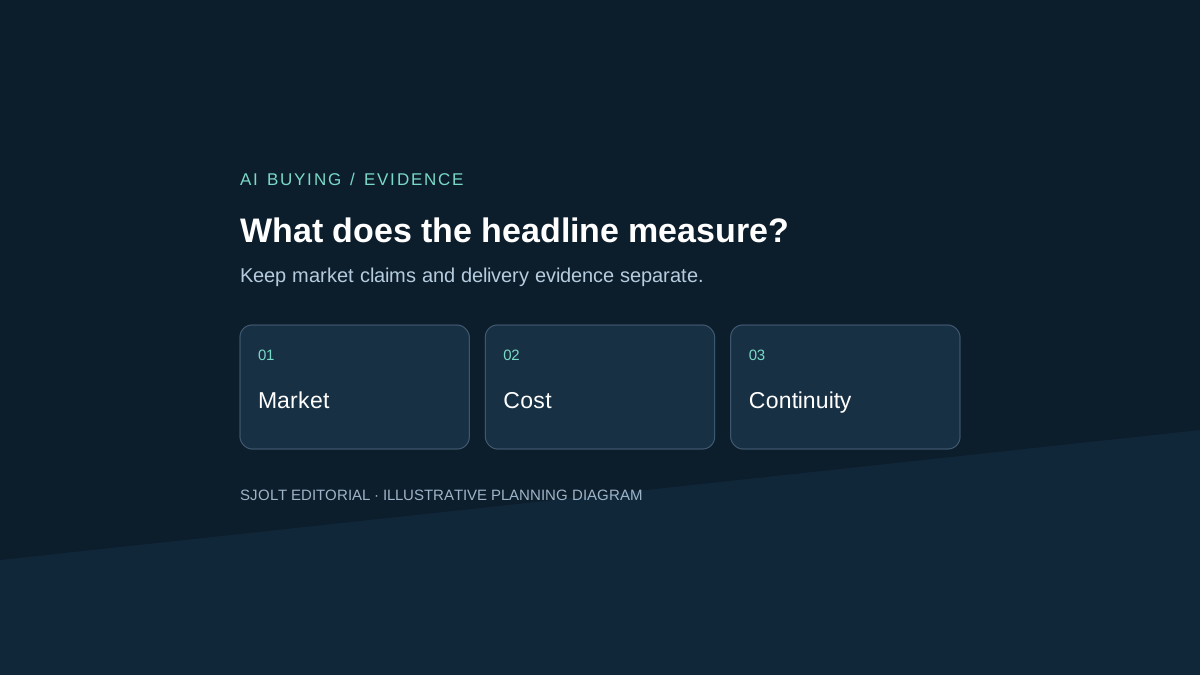
The current China AI bubble discussion concerns a sharp repricing of listed technology companies. Reuters’ October 26 report, republished by Euronext on October 27, describes a roughly 40% STAR50 decline in less than four months and about $480 billion in lost market value. Those are attributed reporting figures, not a price series independently reconstructed for this guide.
For a team buying image or video generation, the useful question is how market uncertainty could affect cost, continuity and delivery. A falling share price does not measure whether a model can complete your brief. Start by separating the market claim from the operating evidence you need, then make a bounded plan for your own workload.
Read the measure behind the headline
The Shanghai Stock Exchange describes STAR 50 as an index representing core companies on its Science and Technology Innovation Board. Its construction uses market capitalization and liquidity, with free-float weighting. That definition is broader than a pure basket of generative-AI service providers. Before repeating a claim about all Chinese AI companies, check which securities the cited index actually represents.
Reuters reports several possible contributors to the reversal, including high valuations and concern about equipment export restrictions; it does not establish one isolated trigger. Do not convert a reported market-value decline into money spent on failed model training. Equity value, cash investment, company revenue and customer spending are different quantities.
| Claim to inspect | Evidence to request | What it cannot establish alone |
|---|---|---|
| The index fell by a percentage | Named index, start and end dates, currency and return convention | The performance of every AI business |
| AI demand weakened | Defined revenue, usage or order data over comparable periods | The cause of a share-price move |
| A service became cheaper | The same task, settings and billing unit before and after | Lower total delivery cost |
| A model is useful | Accepted outputs on a fixed, relevant evaluation set | A fair valuation for its provider |
For your research note, preserve the publication date separately from the date of the observation. A headline about a four-month drawdown should not become a claim that the market lost that amount in one day. Likewise, an index percentage and a dollar estimate need their own denominators. Do not multiply an unrelated market capitalization by the percentage to invent a missing figure.
Ask how a market event reaches your workflow
A practical review needs a concrete transmission path. If a supplier changes a price, removes a model or alters account access, record that actual event and its effective date. A broad market headline can justify checking those dependencies, but it does not establish that any particular API will close or become unreliable.
Make a short dependency map for one deliverable: input assets, model route, generation settings, task status, downloaded output and final editing project. Mark which items live only in a provider account. Keep your approved brief and original assets in your own project so a service change does not erase the work needed to make another version.
For a replacement, identify the capability you depend on. Text-to-video, animation from an opening frame and reference-guided generation are different operations. A second model with a similar name is not a drop-in substitute if it changes reference limits, duration or framing. Check those constraints before promising a fallback to a client.
Use accepted delivery cost as the operating test
Consider an illustrative batch of twenty product images. A manual route costs $120 in active work and produces twenty accepted assets, or $6 each. An assisted route spends $18 on generation attempts plus $45 on preparation and review, but yields only fifteen accepted assets. Its interim cost is $63 divided by fifteen, or $4.20 per accepted image. The batch is still five images short.
If completing those five requires another $30 of manual work, final delivery costs $93 for twenty images, or $4.65 each. The saving against the $120 baseline is $27, or 22.5%. These invented numbers demonstrate the accounting; they are not SJolt prices, observed productivity or a forecast. If the remaining images instead cost $70 to finish, total delivery rises to $133 and the supposed saving disappears.
| Record for each batch | Why it belongs in the calculation |
|---|---|
| All charged attempts | Rejected generations still consume budget |
| Preparation, checking and corrections | Human work is part of production |
| Accepted assets at the required quality | A completed task is not an accepted delivery |
| Remaining work and deadline | An incomplete cheap batch may be unusable |
Define acceptance before starting: correct product features, readable required text, suitable crop and final dimensions. Apply the same standard to both approaches. Record active work separately from unattended waiting, and track the elapsed deadline independently. This avoids treating ten simultaneous jobs as ten times the labour while still exposing a queue that delays delivery.
Run the review with an explicit SJolt contract
SJolt’s model pages and pricing page provide the concrete settings for an image or video task. For example, a Nano Banana 2.1 image-edit workflow accepts raster references; it does not ingest an editable 3D project. Preserve the reference revision, chosen route and quoted settings alongside the resulting task ID. Check the current price when budgeting instead of copying a market-news article’s number.
You can rehearse task bookkeeping with local fixtures before purchasing generations. Include success, failure and an unresolved response. After receiving a task ID, query that task before submitting another attempt. If no ID arrives, investigate the uncertain submission rather than assuming it never started. Keep the final output with the brief and review notes so your delivery record survives changes in a hosted interface.
Write a decision that can be revisited
Conclude the review with a workload-specific decision: continue a bounded batch, compare another supported route, or pause expansion until an unresolved constraint is answered. Set a spending cap and an acceptance threshold in advance. A service-price change, repeated missed deadlines or documented model retirement is a useful review trigger; a daily change in a stock index is not itself a measurement of your delivery process.
For the China AI bubble question, the defensible conclusion is limited: reported market valuations have fallen sharply, while the usefulness and cost of a particular workflow need separate evidence. Keep those two records connected by explicit assumptions. This guide evaluates purchasing and production decisions; it does not estimate fair stock values or predict whether the market will recover.
Sources & further reading
Take the next idea into production.
Explore the models, test a workflow in the playground, and use the same request in your application.