
AI research
Anthropic, AI Labor and Consciousness: What the Evidence Says
The debate combines three different questions: possible model experience, product rules and changes to human work. Read each against its own evidence before changing your workflow.
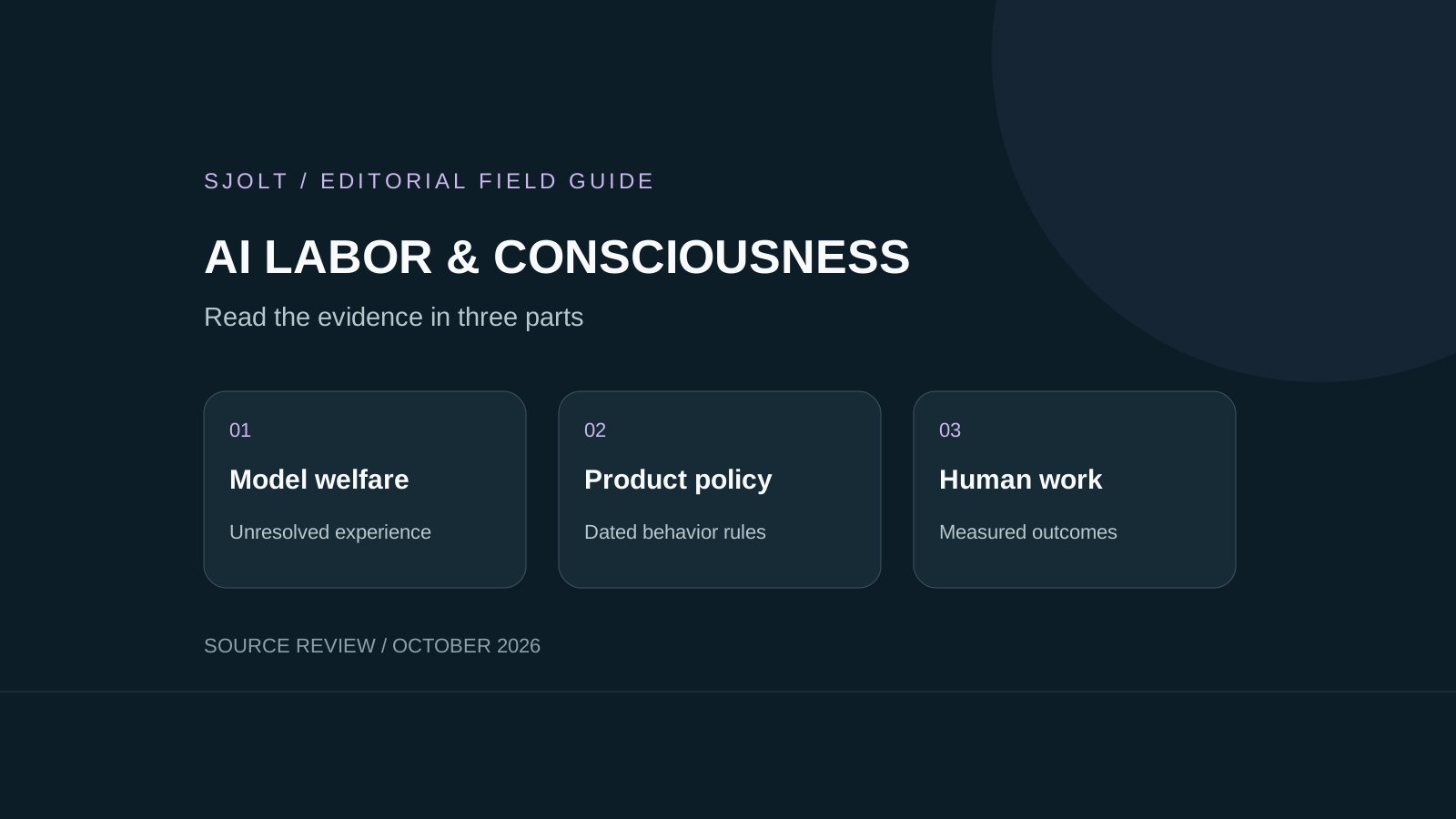
Anthropic’s public research does not establish that Claude is conscious. Its model-welfare program treats possible experience as an unresolved question. That question is distinct from how a product handles abusive interactions and from how AI adoption changes human jobs.
If you are researching “Anthropic AI labor and consciousness,” start by separating those claims. For a team using AI to prepare creative briefs or code, the practical decision is how to keep work measurable, correctable and attributable without turning uncertain philosophical claims into product facts.
What Anthropic has actually said
Anthropic launched its model-welfare research program in April 2025. It describes uncertainty about whether AI systems might have experiences deserving moral consideration and how such questions could be assessed. A research program under uncertainty is not a declaration that present models are conscious, nor does it settle their moral status.
Its research on emotion concepts identifies internal representations with behavioral effects. The authors explicitly distinguish that finding from conclusions about subjective experience. An emotionally worded answer and a measurable behavioral mechanism are different kinds of evidence; neither should be presented as a completed consciousness test.
When reading a viral claim, write down the observation separately from the interpretation. For example, a model refusing a task is an observable behavior. The claim that it refused because it suffered adds an explanation that the observation alone cannot establish. Apply the same discipline to confident claims that the research has definitively ruled experience out.
A policy announcement has an effective date
Anthropic’s October 8 announcement says the updated Usage Policy takes effect November 12, 2026. As of this October 19 review, that date is still ahead. The new abuse provision targets repeated, purposeless cruelty in extreme cases; the announcement excludes ordinary frustration, pushback, dark creative themes, and model testing or research from that provision.
The announcement also describes ending persistently abusive interactions in Claude.ai and Claude Code as the primary enforcement mechanism. Do not assume that a specific interface behavior is an API field or a feature inherited by every service using Claude.
For an editorial review task, give clear corrective feedback: identify the missing citation, wrong dimension or unsupported statement and request a bounded revision. Keep an unresolved disagreement visible for a person to decide. There is no need to invent a model’s emotional state to explain either a quality failure or a product boundary.
What the employment study measures
Anthropic’s October 16 study concerns its own workforce. It reports that junior employees’ share of technical departments fell from 21% to 14%, while their share of technical hires fell from 27% to 9%. Technical hiring still grew in absolute terms. These are different denominators; the percentages are not counts of layoffs.
The study combines internal records with 17 interviews and describes human attention as a constraint on growing agent output. It is evidence about one unusually AI-intensive company, not a universal employment forecast or evidence about model consciousness.
For your team, measure the entire handoff rather than celebrating the number of drafts. An assistant that produces ten options but doubles review time may not have improved delivery. Record the time spent preparing instructions, checking claims, correcting outputs and handing work to the next person. Keep training and review opportunities visible for less experienced teammates.
Turn the distinction into a small workflow
Consider a campaign brief that must become a product image. Give one person ownership of approved facts and another the authority to accept the visual. The assistant may organize those facts and propose a composition, but the review record should say who approved each decision. This is an editorial workflow recommendation, not a result reported by Anthropic.
| Stage | Useful record | Acceptance question |
|---|---|---|
| Brief | Source, exact claim and unresolved question | Can the claim be checked without asking the model again? |
| Draft | Revision and requested change | Did the revision preserve approved facts? |
| Visual | Task ID, selected file and rejection reason | Does the image satisfy the actual brief? |
| Handoff | Reviewer and approved version | Can the next person find and revise the right asset? |
Start with three historical briefs whose outcomes are already known. Have the assistant produce the same structured review for each, then compare missing facts and correction effort. Include a case with conflicting instructions so that asking for a decision can count as success. Do not score every refusal or clarification as a failure.
- Limit the number of revision rounds and preserve the previous version.
- Separate a service error from a rejected creative choice.
- Record review time and accepted deliverables, alongside generation costs.
- Escalate unsupported claims to the owner of the brief.
Apply it to a supported SJolt handoff
SJolt’s current catalog includes Claude Sonnet 5.5 for language tasks and Nano Banana 2.1 for image generation and reference-guided editing. Those are separate model contracts. A text model can help structure a brief; producing a raster image requires the image route. Neither listing claims to measure consciousness or reproduce Claude.ai’s conversation-ending behavior.
Use an approved brief revision as the image request’s input. Retain its task ID, inspect the returned file and mark acceptance separately from task success. If the image is wrong, state what failed before submitting another attempt. The useful output is a traceable decision and an inspected asset. No paid request or workplace experiment was run for this guide.
Sources & further reading
Take the next idea into production.
Explore the models, test a workflow in the playground, and use the same request in your application.