
AI research
Google AI Plasma Confinement Research: What the Paper Establishes
The October paper extends exact plasma-equilibrium families. Follow the earlier research, the authors’ AI disclosure and a practical evidence-to-explainer workflow.
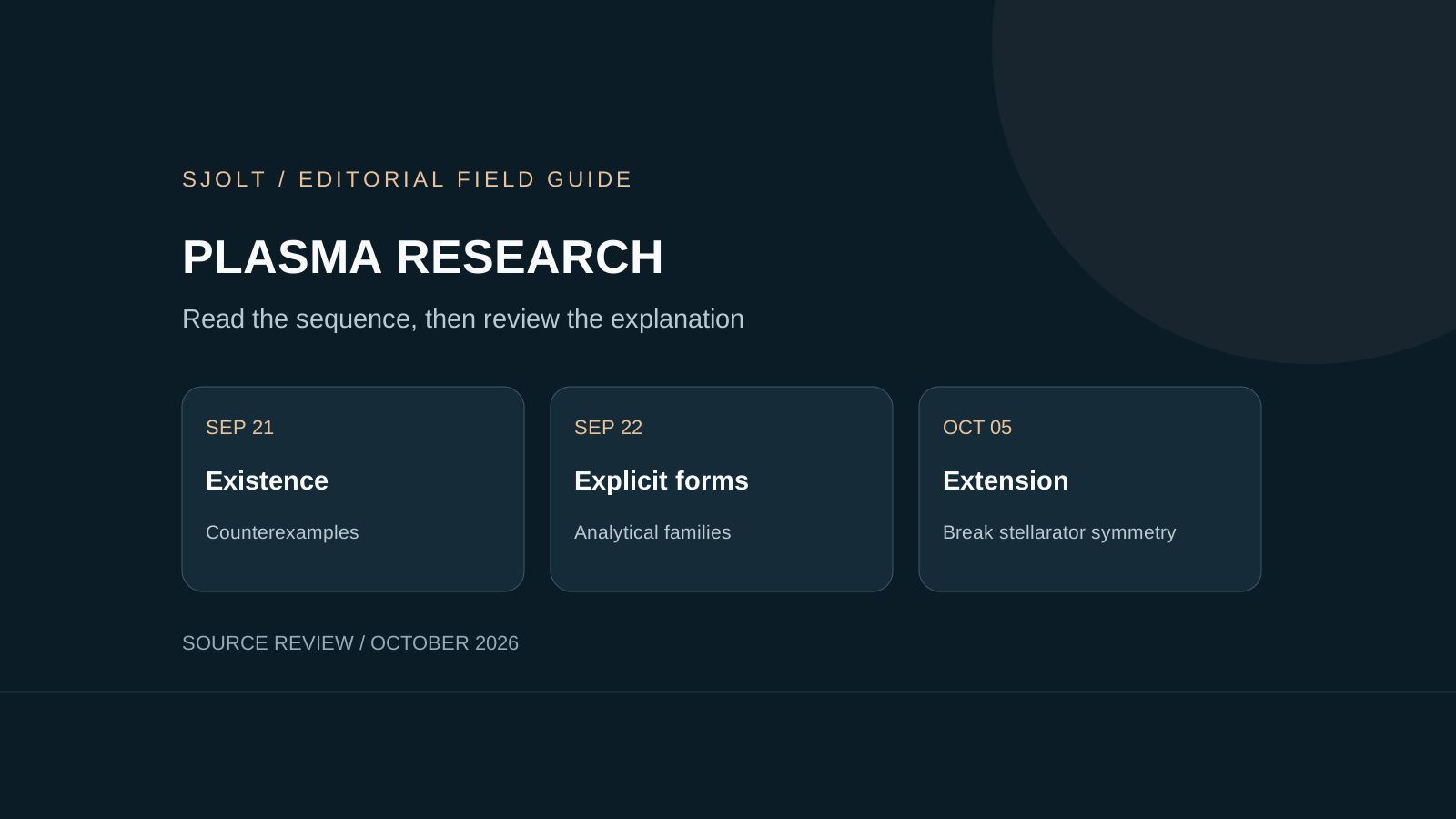
The October 5 preprint by Opal Issan, Jonathan Citrin, Matt Landreman and Brendan Tracey extends two analytical plasma-equilibrium families to break stellarator symmetry. It supplies reference cases for checking numerical equilibrium solvers. This is a mathematical result, not a reported electricity-generating reactor experiment.
For readers following “google ai plasma confinement research,” the useful questions are what changed, what the authors verified and which claims a summary can support. The procedure below is an editorial review workflow. It does not reproduce the physics calculation or claim a new scientific result.
Read the research in chronological order
On September 21, Gómez-Serrano, Liehr and Taylor posted Counterexamples to Grad’s conjecture. Their abstract describes smooth equilibria with nested toroidal pressure levels and specific discrete symmetries, without the plane-reflection, axial or helical symmetries in the conjecture. It also reports Lean 4 certification.
Landreman’s September 22 paper presents explicit analytical families using elementary functions, with a constant rotational transform in one family and a sheared profile in the other. Its abstract emphasizes their usefulness for understanding three-dimensional equilibria and testing numerical codes. The currently listed revision is September 28.
The October follow-up introduces a symmetry-breaking parameter for each family; setting it to zero recovers the corresponding earlier solution. Read it as an extension of that sequence. An October news publication date should not be substituted for the paper’s submission date.
Keep the authors’ AI disclosure attached to the result
Section 5 describes Gemini 4 agents in Google Antigravity proposing extensions, with promising candidates appearing within hours. It also names Argon for manuscript and verification-code assistance. The authors say they selected and steered the problem, independently re-derived and symbolically checked every derivation, and took responsibility for the paper.
When writing a short explanation, preserve both the candidate-generation step and the verification step. “Within hours” should not become an estimate for the entire project or a claim that human checking was unnecessary. A model name by itself tells the reader little about which materials, tools and review process were involved.
Keep a claim log while reading: source version, section, proposed wording, reviewer and unresolved question. If a sentence describes a numerical result, attach the exact table or equation that supports it. If it describes a role in the research, use the disclosure section. This prevents a narrative summary from gradually becoming stronger than its evidence.
Use a three-pass review for a scientific explainer
First, make an evidence-only outline. Give each paragraph one job: identify the problem, explain the new contribution, describe validation or state a practical limit. Remove sentences that cannot be assigned to a source or clearly marked as an inference. Keep source dates visible in the working draft even if the final narration is short.
Second, ask a technically qualified reviewer to challenge the scope. Does the explanation preserve the distinction between an equilibrium and a claim about how an operating device behaves over time? Does a rendering suggest measured performance that was never supplied? Does “AI discovered” hide earlier work? Write down the revision required for each objection.
Third, check the final asset rather than only the script. Captions, thumbnail text and diagrams can introduce claims that the prose carefully avoided. Give the reviewer the exported file at the intended screen size. Keep a transcript so that viewers can follow the sources without reading labels embedded in a small image.
| Draft element | Review question | Concrete correction |
|---|---|---|
| Headline | Does it promise a working reactor? | Name the analytical-equilibrium contribution |
| Timeline | Are news and paper dates mixed? | Use submission dates beside the papers |
| AI credit | Is verification visible? | Add the authors’ checking and responsibility |
| Figure | Is it calculated, copied or illustrative? | State its origin in the caption |
These are proposed editorial checks, not additional findings from the paper. A clean checklist cannot certify a derivation. If the task is to validate physics, keep the source equations, boundary assumptions, code and specialist review together and report what actually ran. Do not treat model-generated agreement as an independent proof.
Use SJolt for source-based drafting and reviewed visuals
SJolt currently supports Gemini 4 Argon for text generation and image understanding. Its catalog documents google/gemini-4-argon for Chat Completions and a native Gemini interface. That access does not recreate the authors’ Antigravity environment, their tools or their research validation.
Supply the relevant paper excerpts and ask for a bounded draft. An original prompt fixture is below. Replace the placeholders with source text; a URL alone should not be treated as proof that your request retrieved the page.
Using only the supplied excerpts, write a 120-word explanation for a general audience.
Separate the mathematical contribution, the reported AI role and the authors’ verification.
Cite the supplied section labels. Mark unsupported claims as unknown.
Do not infer reactor performance, commercial readiness or a reproduced experiment.

[Source A: abstract and introduction]
[Source B: use-of-AI disclosure]
[Source C: earlier-paper abstract]
For a visual brief, use a timeline or a diagram of the review process. If an illustrative background is useful, SJolt’s Nano Banana 2.1 image workflow is available separately. Keep field-line plots and numerical charts tied to real source data or calculation code. A generated torus image cannot verify a magnetic configuration.
Save the source versions, approved wording, diagram provenance and final review notes with the deliverable. This article used source reading and offline content validation; it ran no plasma solver, formal proof checker or paid generation. The goal is a traceable explanation that readers can check against the original research.
Sources & further reading
Take the next idea into production.
Explore the models, test a workflow in the playground, and use the same request in your application.