
Research workflows
OpenAI’s Impact on Mathematics: Results, Proofs and Human Review
AI-generated manuscripts, machine-checked statements and understood mathematics are different milestones. Follow a result through its version history and verification scope before relying on it.
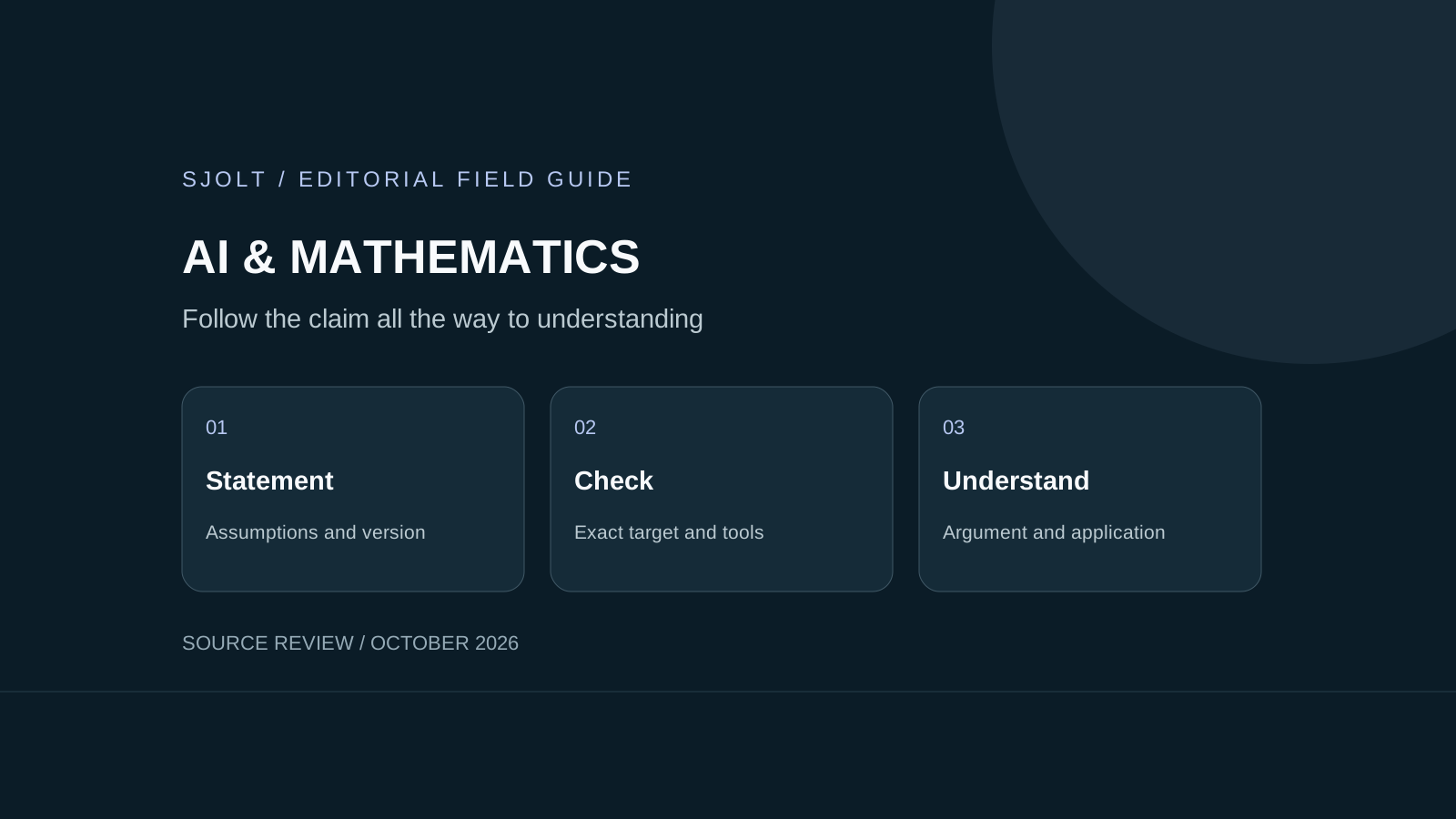
OpenAI’s impact on mathematics is best assessed through specific results and the work needed to validate and understand them. Its October 6 release contains research produced by an internal model. That is evidence of a research program, not a guarantee that a public chatbot or API reproduces each result.
For a reader or application builder, the useful habit is to separate a proposed argument, a checked formal statement and a result you can correctly apply. This guide reviews the public artifacts and offers a small original exercise. It does not independently certify the release’s research theorems.
Read the release as a versioned collection
At this October 24 review, the repository README lists 719 manuscripts in 372 families and reports roughly 42% of top-line results as formalized. It says some unformalized results may contain issues. The system that produced the collection is described as an unreleased internal model; do not infer a public API identifier from the announcement.
The history records three manuscript withdrawals on October 7 after a sign error affected an argument and dependent work. It also records repairs to other papers and updates to their references. That makes the manuscript version and its dependencies part of the claim, not optional citation detail.
Before sharing a result, save the repository commit, paper path, theorem number and any withdrawal or revision notice. Read the assumptions in the actual paper. A family title is an index entry; it may contain companion results, variants or consequences with different scopes.
What exactly did the formal check cover?
The Comparator instructions explicitly distinguish several checks of supporting results from checks of the associated papers’ main theorems. A green build for one supporting statement therefore cannot justify announcing that the entire paper has been verified. The repository also recommends compiling small portions of its Lean library.
| Artifact | What to inspect | What it does not establish alone |
|---|---|---|
| Natural-language paper | Exact statement, hypotheses and dependencies | Correctness merely from polished exposition |
| Formal theorem | Definitions, assumptions and match to the paper | That the intended informal claim was encoded |
| Verification log | Pinned tools, target and successful exit | Coverage of unbuilt or unrelated theorems |
| Human exposition | A clear argument and answers to objections | Community consensus from one reviewer |
For a serious review, choose one theorem and follow its references until you understand which inputs are proved locally and which are assumed. Record failed build attempts too. Fixing an environment problem is different from repairing a proof, and both differ from changing the theorem to make a check pass.
Impact includes understanding, access and review capacity
The independent Advisory Group on Mathematics and Artificial Intelligence emphasizes human understanding, responsible attribution, persistent versioned releases and community-led follow-up. Its September recommendations also object to testing advanced mathematical problems on proprietary systems unavailable to the community. Consulting the group should not be described as its endorsement of every released result.
The Simons Foundation’s October 15 announcement describes $15 million in combined funding and resources with Anthropic and OpenAI, with the foundation managing awards. OpenAI separately identifies its own $5 million contribution. These initiatives support evaluation and understanding; funding is not proof that a particular theorem is correct.
A useful assessment of impact asks whether researchers can explain new methods, reuse them in later work and correct errors efficiently. Counting manuscripts alone misses that work. A collection can introduce valuable ideas while still containing statements that need repair or narrower interpretation.
Practice on a small retry-budget claim
The following original toy problem makes the distinction between calculation and applicability concrete. Suppose an image-review workflow accepts each independent attempt with fixed probability p, charges a constant c per attempt and stops at the first accepted result or after n attempts. Assume 0 < p ≤ 1 and a positive integer n. These are hypothetical assumptions, not SJolt performance or pricing.
Attempt k+1 is reached only if the first k attempts failed, with probability (1−p)^k. Summing these probabilities gives expected attempts as [1−(1−p)^n]/p. Multiply by c for expected generation cost. The chance of at least one accepted output is 1−(1−p)^n, while the maximum generation cost is n×c.
from fractions import Fraction

# Hypothetical independent trials; these are not model measurements.
p = Fraction(1, 2)       # probability an attempt is accepted
c = Fraction(4, 100)    # assumed cost of each attempt
n = 3                  # stop after success or three attempts
expected_attempts = sum((1 - p) ** k for k in range(n))
success_probability = 1 - (1 - p) ** n
expected_cost = c * expected_attempts

assert expected_attempts == Fraction(7, 4)
assert success_probability == Fraction(7, 8)
assert expected_cost == Fraction(7, 100)
assert expected_cost / success_probability == Fraction(8, 100)
assert n * c == Fraction(12, 100)
print(expected_cost, success_probability, n * c)
With p=1/2, c=$0.04 and n=3, expected generation cost is $0.07, success probability is 7/8 and the maximum is $0.12. The ratio of expected cost to success probability is $0.08. It describes long-run cost per successful capped batch under the assumptions; it does not guarantee that any one batch succeeds or costs that amount.
Now challenge the assumptions. Retries with an unchanged defective reference can have correlated failures. Editing the prompt changes the acceptance probability. Human review adds cost. A route may charge differently across resolutions. The algebra can be correct while the business conclusion is wrong because the inputs do not describe the actual workflow.
The Python fixture was checked locally using exact rational arithmetic. It is not a Lean proof, a model benchmark or validation of the OpenAI research collection. For a production estimate, define acceptance first, collect comparable observations and report uncertainty rather than inventing a success rate.
Use a model to assist review, then verify outside the answer
SJolt lists GPT-6.1 Sol for text-and-image reasoning through Chat Completions and Responses. You can use a supported model to organize assumptions, suggest counterexamples or draft a checking script. That catalog entry is not access to the internal mathematics system behind OpenAI’s release, and it does not provide a hosted Lean verifier.
Keep the model’s proposed argument, your independently run checks and the reviewer’s decision as separate artifacts. Ask a second pass to find a counterexample under the stated assumptions, then inspect its reasoning. Agreement between generated answers can guide investigation; a reproducible check and a valid argument carry the conclusion.
Sources & further reading
Take the next idea into production.
Explore the models, test a workflow in the playground, and use the same request in your application.