
Research workflows
Claude and Harvard Research: Build a Reproducible AI Workflow
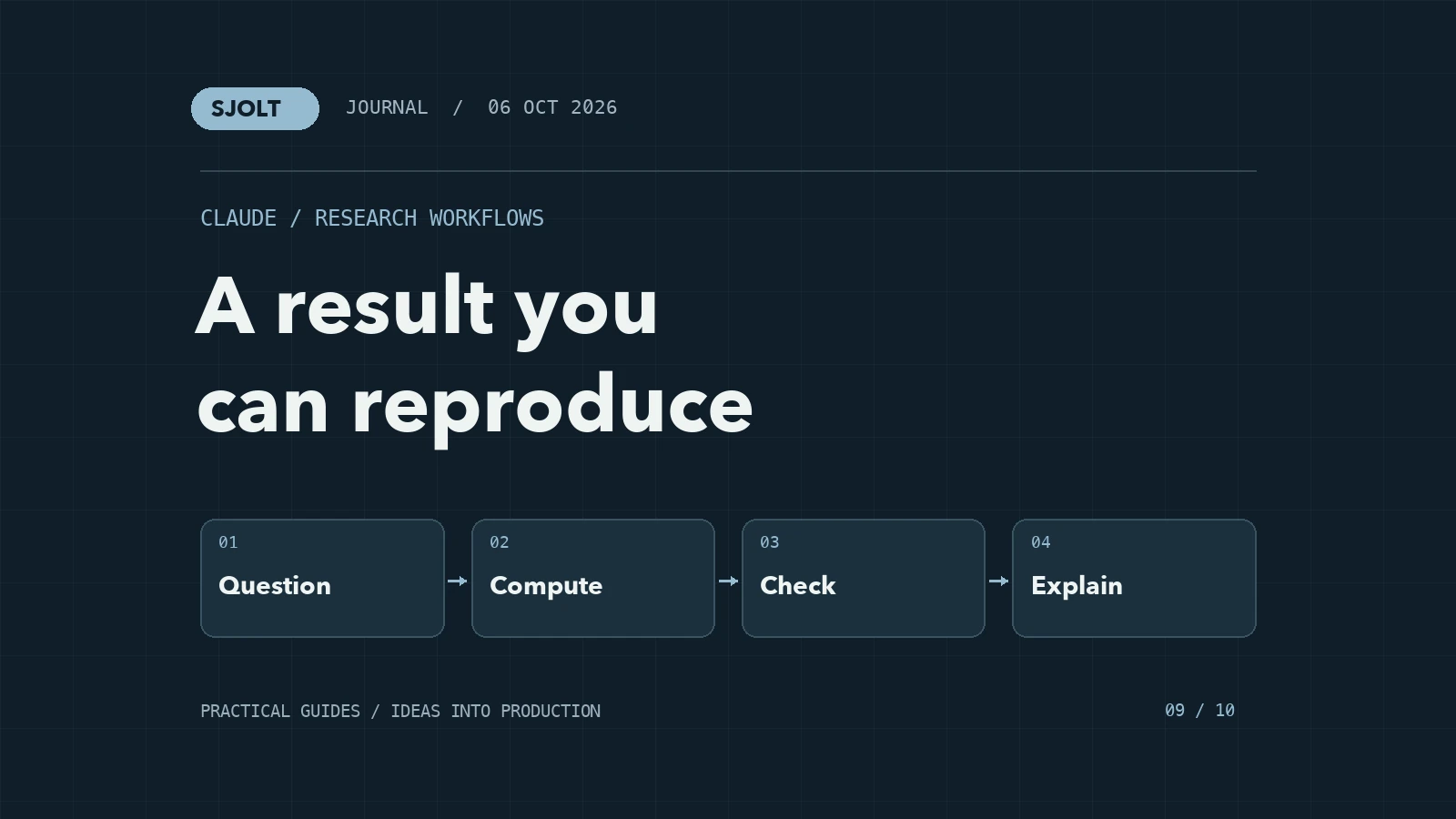
The useful lesson from Claude-assisted research is the connection between a well-chosen question, inspectable computation, and expert judgment. Build those into your own workflow.
The Claude and Harvard research discussion points to work by Harvard physicist Matthew Schwartz. In his October 1, 2026 guest post on Anthropic’s site, he describes using Claude and a toolkit called BootLoops to pursue quantitative problems suited to the system’s strengths.
The post emphasizes collaboration with domain experts: a technically interesting calculation still needs a scientifically meaningful question. For teams using Claude through SJolt, that distinction is a useful starting point for building a reproducible research-assistance workflow.
What the research account describes
Schwartz describes connecting computational methods across fields and using expert feedback to turn initially unremarkable results into more relevant questions. He also stresses that scientific progress still depends on data, checking, and repeated investigation. This is an account of a research process, not evidence that a single prompt can replace a laboratory or independently validate a scientific claim.
The workflow proposed below is our practical adaptation for document analysis and computational review. It does not reproduce BootLoops, claim to replicate its results, or imply that a particular research tool is included with an SJolt API request.
Choose a task with an inspectable answer
Start with a bounded assignment: extract assumptions from a set of papers, compare two methods using a fixed dataset, or review an analysis script against a written specification. Avoid beginning with an open request to discover something important. The first objective is to establish whether the model can help with a step you know how to verify.
| Task | Evidence the reviewer should receive |
|---|---|
| Literature comparison | Source identifiers and exact locations for each claim |
| Method review | Assumptions, input requirements, and identified limitations |
| Code assistance | A proposed change plus checks against known cases |
| Result explanation | A link from each interpretation to the relevant output |
| Research communication | A clear separation between measurements and illustration |
Keep an answer key or a small reference example whenever possible. For a numerical method, include a case with a known solution. For a literature comparison, identify at least one claim the papers disagree about. These anchors make it harder for a fluent but shallow summary to look complete.
Prepare a source packet before asking for synthesis
Assign stable identifiers to the papers, excerpts, datasets, and scripts. State which versions are included and what the model is allowed to infer. If the source packet is incomplete, ask the model to list the missing evidence rather than fill the gaps with plausible background knowledge.
Review the supplied excerpts A, B, and C.
For each proposed claim, return:
1. The claim in plain language.
2. The supporting source ID and section.
3. Assumptions required for the claim.
4. Conflicting or missing evidence.
5. A concrete check a human can perform.
Do not invent citations or treat a hypothesis as an observed result.
This output structure helps a reviewer move from prose back to evidence. It is especially useful when the model combines several documents: an apparently coherent answer can otherwise hide that a conclusion came from only one weak source. Keep quotations short and return readers to the original publication for the full context.
Use the supported Claude surface on SJolt
SJolt provides Claude Opus 5.5 through native Anthropic Messages with text and image input and text output. Its route can help analyze supplied material and propose code or explanations. A call to that endpoint does not automatically search the web, execute a notebook, or provide the Claude Science product.
For an initial experiment, use a curated text packet and a specific question in the Playground. For an application, keep system instructions in the top-level system field, provide messages and max_tokens, and parse final text blocks from content. Use the model’s documented adaptive-thinking controls rather than copying settings from an OpenAI-format request.
If your application supplies tools, keep their execution records with the analysis. Store the code that ran, the input version, the environment, and the resulting files. A model’s statement that a computation succeeded is not a substitute for the actual execution output.
Make independent checking part of the loop
- Recompute a small subset using a separate implementation or a known reference result.
- Check units, normalization, missing values, and assumptions before interpreting a graph.
- Inspect cases that disagree with the hypothesis instead of selecting only supporting examples.
- Ask a domain expert whether the question and effect are meaningful, even when the arithmetic is correct.
- Preserve rejected hypotheses and the reason for rejection so the next iteration does not repeat them.
A useful division of work is to let the model propose and organize, let tools compute, and let reviewers examine both the evidence and its significance. The boundaries can evolve as you gain experience, but each result should still have a path back to something inspectable.
When the model proposes a new explanation, label it as a hypothesis until you have evidence that supports it. When it restates an established result, retain the citation. Treat those as different output types throughout your notes and presentation.
Keep research evidence separate from generated visuals
SJolt image and video models can help create a conceptual illustration or an explanatory sequence after the findings have been checked. Label that material clearly. Generate plots of measured or simulated data with the analysis tools that produced the data, so the figure can be regenerated from the same inputs.
For an explainer, make a scene list that says which parts are actual results and which are visual metaphors. A generated animation of a process can help an audience understand a hypothesis, but it is not a measurement or a validation of that hypothesis.
The strongest output of an AI-assisted research workflow is a package someone else can inspect: sources, assumptions, code, results, and a clear statement of what remains uncertain. That package is more useful than a polished answer whose evidence cannot be recovered.
Sources & further reading
Take the next idea into production.
Explore the models, test a workflow in the playground, and use the same request in your application.