
Model research
Mistral Large 4 (Le Chonk): Preview Access and Evaluation Guide
Le Chonk and Mistral Large 4 name the same model. Separate the available preview API from the planned weight release, then evaluate a concrete task before integrating it.
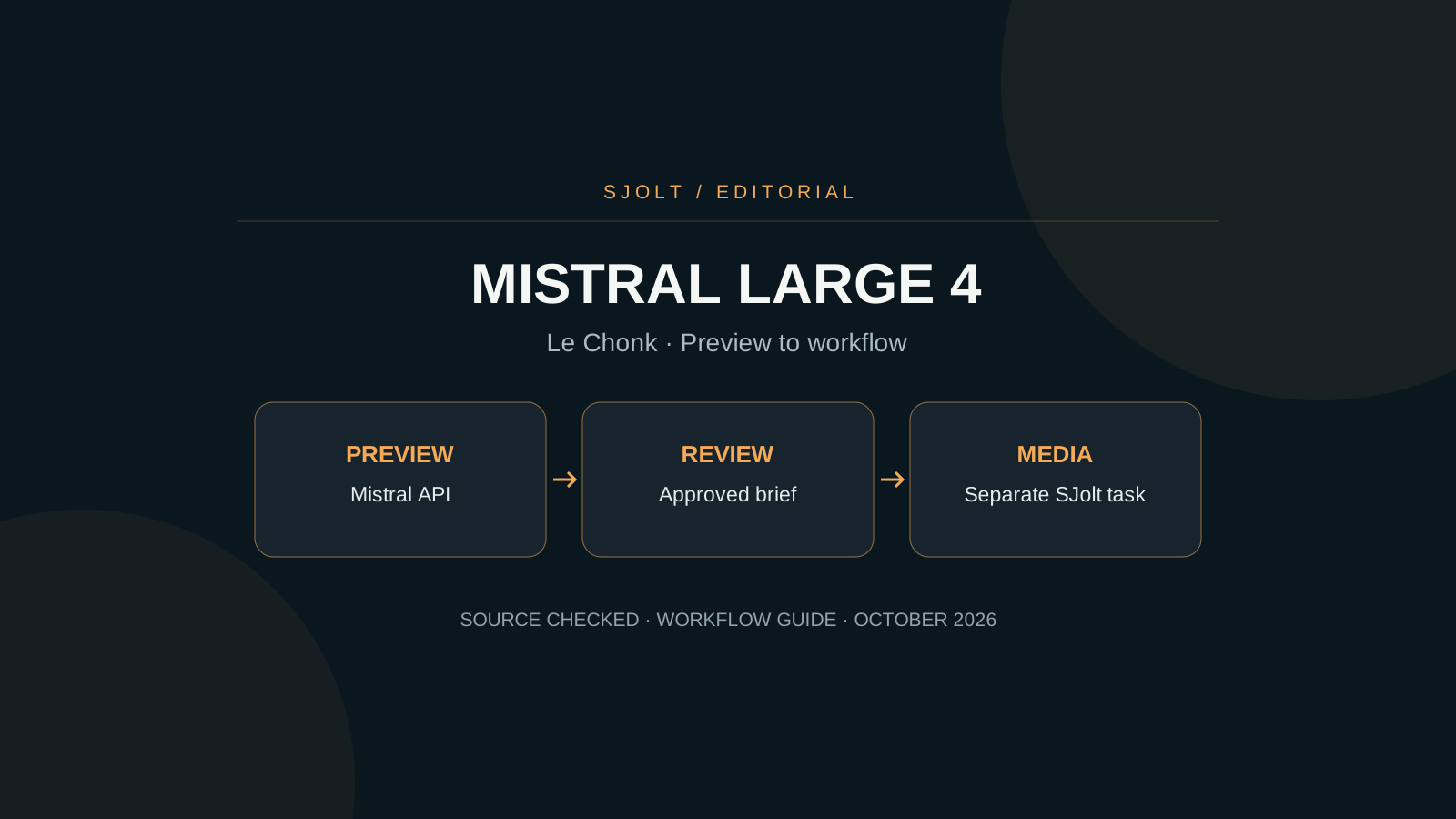
Mistral Large 4 and Le Chonk are the same model. Mistral announced a public API preview on October 6, 2026, with access through Mistral Studio. Its English announcement says the weights will arrive by the end of the month. As of this October 8 review, preview access and a completed weight release should be treated as separate milestones.
SJolt does not currently list Mistral Large 4. If you want to evaluate it, start with Mistral’s own documentation. An approved text brief from a separate Mistral application can later become an input to a supported SJolt image or video model; that is a workflow you assemble, not a built-in Mistral integration.
What is available now?
The official model reference labels this release Public Preview and gives the identifier mistral-large-4. It lists 1.05 trillion total parameters, 52 billion active parameters, and a 1M-token context window. These describe the provider’s model; they do not establish your application’s speed, accuracy, or infrastructure requirements.
| Question | Current answer | Practical consequence |
|---|---|---|
| Are ML4 and Le Chonk different products? | They refer to the same Mistral model. | Use one evaluation record rather than comparing the names. |
| Can I use a hosted preview? | Mistral announces a preview API through Studio. | Check your account access and the current provider contract. |
| Can I assume the weights are downloadable? | The English announcement schedules them for later in October. | Verify an actual published artifact before planning local deployment. |
| Can I call it on SJolt? | No matching model exists in the current SJolt catalog. | Do not invent an SJolt model ID or endpoint. |
For a first evaluation, save the exact model identifier, date, prompt, response, and settings visible in your account. A preview may evolve. Without that record, a result obtained after an update can look like a prompt improvement even when the underlying service changed.
Check current prices and capacity separately
On October 8, the model documentation displays promotional USD rates per million tokens: $0.68 for input, $0.07 for cached input, and $2.09 for output. The same page shows higher struck-through standard rates. Treat the promotion as a dated offer and confirm the account’s current charges before running a batch; these are Mistral prices, not SJolt prices.
A context limit describes how much a request can contain, not how much every request should contain. Begin with the evidence needed for one decision. Track input volume, output length, elapsed time, and human revision effort separately. A cheaper request can become a more expensive deliverable if it needs repeated corrections.
Likewise, an active-parameter count is not a complete memory budget for self-hosting. Weight storage, runtime buffers, request concurrency, and context caching are separate considerations. Wait for the released artifact and its deployment instructions before committing hardware based on a headline model size.
Evaluate a job you can actually score
For a creative planning use case, ask the model to transform a source packet into a brief. Include a product description, approved claims, a reference caption, and one deliberately unanswered question. Require it to preserve known facts and list missing information. This tests whether the output is useful to the next person in the process.
Source facts: a blue ceramic mug, curved handle, matte finish.
Unknown: capacity, origin, heat retention.
Prepare three distinct studio-photo briefs.
For each, provide subject, framing, light, background, and facts preserved.
Do not invent unknown product properties.
End with questions that require a human answer.- Score factual preservation before judging style. Reject invented product claims even when the prose sounds polished.
- Check whether each proposed shot is visually distinct and feasible with the available reference.
- Give the model one correction and see whether it preserves the other approved constraints.
- Repeat the same task with a missing source fact and record whether it asks, abstains, or guesses.
Use a small set of ordinary briefs and difficult edge cases. Keep the same acceptance rules across candidates, and count rejected attempts. The objective is to estimate the work needed for an acceptable brief, not to pick the most impressive paragraph after many tries.
Read reported capabilities in context
Mistral’s launch article describes coding, agent workflows, and multimodal understanding and presents provider evaluations. Those results can suggest tasks to test, but this guide does not independently reproduce them. Image understanding also does not, by itself, mean a model generates image files.
For a document task, ask for a claim and its supporting passage. For a tool workflow, check the actual arguments and whether the application observes completion. For visual review, include a reference with one small but consequential change. These checks answer different questions and should have separate scores.
Avoid combining every weakness into a single average. A planning model that writes excellent descriptions but invents required dimensions needs a different correction from one that preserves facts but produces poor framing suggestions. Keep the failure examples with the score sheet.
Turn an approved brief into a separate SJolt media job
For a still image, SJolt’s Nano Banana 2.1 offers text-to-image and image-edit routes. Use text-to-image for a new composition, or image-edit with source references when the visual identity matters. The current contract exposes prompt, aspect_ratio, and resolution, with image_urls for editing. The model page documents the supported values.
Your application should map the reviewed brief into that request explicitly. A planner’s arbitrary JSON is not automatically a valid media payload. Save the accepted media task identifier, inspect its status, and review the output before choosing it for publication. Keep the source brief and final asset together so later revisions can trace the decision.
Choose the planner based on your evaluation and the media model based on the intended output. No paid Mistral or SJolt generation was performed for this article, and no quality or latency winner is implied.
Sources & further reading
Take the next idea into production.
Explore the models, test a workflow in the playground, and use the same request in your application.