
Developer workflows
DeepInfer: What You Need Beyond DeepSeek’s Offline Inference Engine
DeepInfer is DeepSeek’s inference framework. Its public release provides offline execution, while a complete service still needs additional infrastructure and application checks.
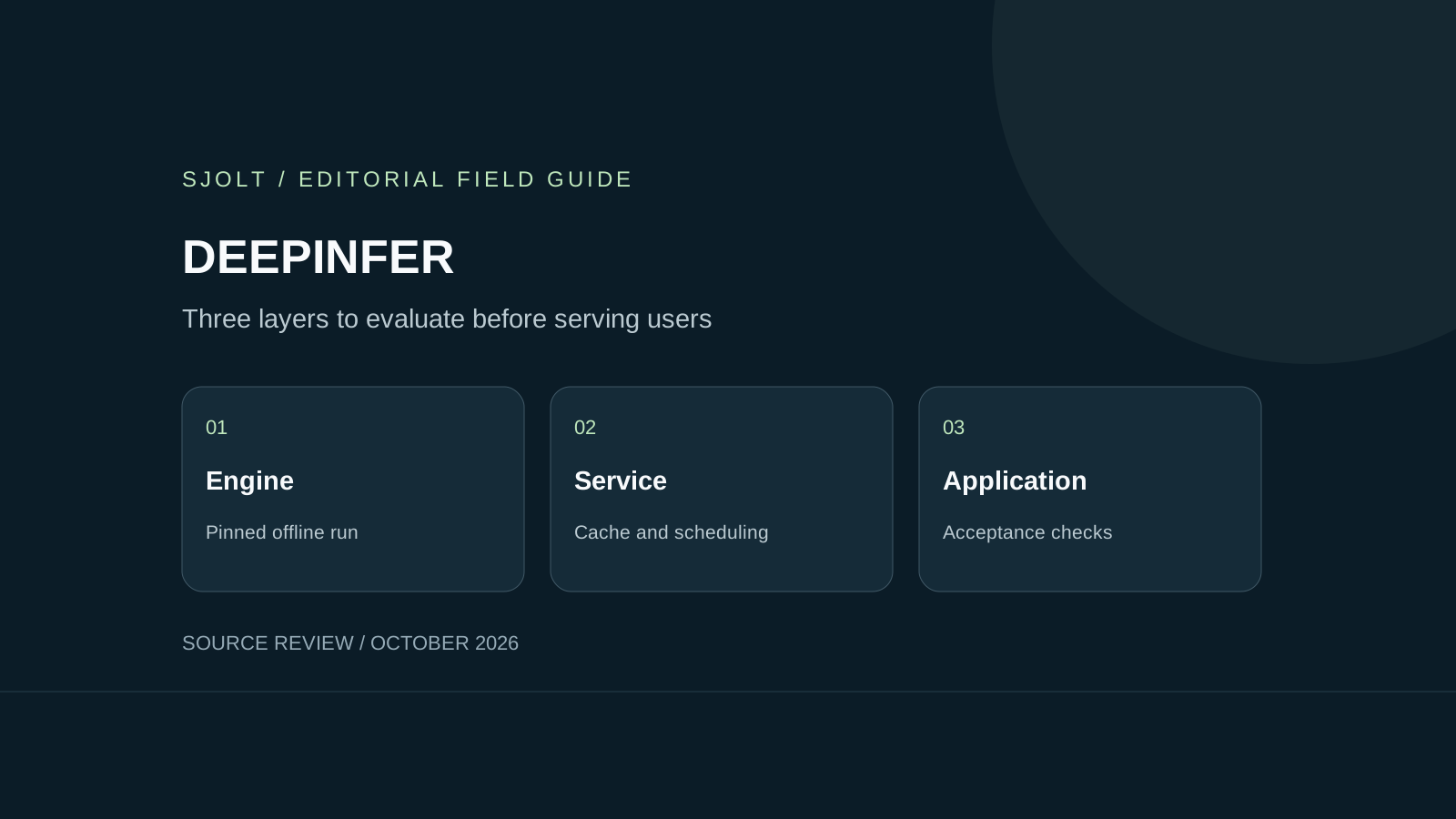
DeepInfer is the inference framework published by deepseek-ai. Its README describes an offline release supporting DeepSeek-V4.1-Flash on NVIDIA SM100 GPUs and Huawei Ascend 950 NPUs. It is infrastructure for running model weights, not a new chat model or an SJolt model identifier.
The practical first decision is whether you are evaluating an inference engine or need an application endpoint today. SJolt does not expose DeepInfer or document it as its serving backend. Existing SJolt DeepSeek model routes have their own supported inputs and version metadata; the framework’s capabilities do not expand those contracts.
Separate the engine from a complete service
The README lists Linux, GCC 13 or newer and Python 3.12, with CUDA 13 for NVIDIA or CANN 9.2 for Ascend. It identifies a KV cache system, vision/prefill/decode disaggregation and balancing across data-parallel replicas as additional work for a complete service. The repository is Apache-2.0; checkpoint terms must be checked separately.
Treat the supported accelerator list as a deployment boundary. A laptop smoke test cannot establish the performance of this release on its intended hardware, and a successful compile cannot establish that a multi-user endpoint is ready. Write down the available devices, interconnect, model storage and owner of each missing service component before allocating an evaluation.
| Layer | Question to answer | Evidence to retain |
|---|---|---|
| Engine | Can this exact build execute the pinned checkpoint? | Commit, checkpoint revision and offline result |
| Service | How are work, cache and failures distributed? | Replica topology and failure-recovery observations |
| Application | Is the output usable for the requested job? | Input fixture, parsed result and acceptance decision |
Make the first milestone narrow: a repeatable offline workload that completes and produces valid outputs. Keep API authentication, quotas, queue policy and cancellation in a separate service design. A small local wrapper around generation is not evidence that those operational requirements have been implemented.
Read the example’s model-loading behavior first
The official offline example defaults to deepseek-ai/DeepSeek-V4.1-Flash-1017. A Hub ID triggers a cache download; a local directory with config.json and safetensors is used directly. DEEPINFER_HF_MODEL_DIR changes the default location but does not override an explicit --model_name. Confirm the selected source before starting a large run.
For a proposed evaluation, save a manifest with the runtime commit, checkpoint revision, local directory, device inventory, parallel configuration and prompt IDs. Keep that manifest beside the output logs. Pin one configuration while investigating a failure; changing the weights, parallelism and sampling settings together prevents useful comparisons.
The examples document --check_structured_output for regex, JSON and grammar checks plus normal end-of-sequence termination. It is not enabled by every ordinary offline invocation. Choose whether the check belongs in your acceptance run rather than assuming that a few printed sample completions exercised it.
Do not refresh expected baselines merely to make a changed result pass. First determine whether the change is intended, reproduce it and save the explanation. Baseline maintenance is a review decision. This article did not build DeepInfer, download weights or run inference.
Validate meaning after constrained generation
The repository’s structured-output example supplies so_args to SamplingParams and separately checks completion, EOS and the decoded result. Its JSON case uses json.loads and checks keys and allowed values. Follow that separation in your own integration: a parseable object is only the first acceptance condition.
For a creative planner, an original fixture could request exactly three shots whose positive integer durations sum to six seconds. The checker below runs against a supplied result. It is application validation, not a DeepInfer API call or evidence of model accuracy.
def validate_plan(plan):
    if not isinstance(plan, dict) or set(plan) != {"shots"}:
        raise ValueError("Expected only a shots object")
    shots = plan["shots"]
    if not isinstance(shots, list) or len(shots) != 3:
        raise ValueError("Expected exactly three shots")
    for shot in shots:
        if not isinstance(shot, dict) or set(shot) != {"prompt", "seconds"}:
            raise ValueError("Unexpected shot fields")
        if not isinstance(shot["prompt"], str) or not shot["prompt"].strip():
            raise ValueError("Missing shot prompt")
        if type(shot["seconds"]) is not int or shot["seconds"] <= 0:
            raise ValueError("Duration must be a positive integer")
    if sum(shot["seconds"] for shot in shots) != 6:
        raise ValueError("Total duration must be six seconds")
    return plan
Test the checker with a valid 2/2/2 plan, a 2/2/3 plan, an empty prompt and a Boolean duration. Rejecting True matters because Python treats booleans as integers in some checks. Keep failed outputs as test evidence instead of quietly repairing them and reporting success.
A reviewer still needs to check visual feasibility, prohibited assumptions and whether the prompt describes the intended product. Structural constraints cannot establish those judgments. Only hand the accepted plan to a generation workflow after that review.
Read throughput as a workload-specific measurement
DeepInfer’s README attributes its plots to four SM100 GPUs for prefill and 64 for decode within scale-up domains. The examples distinguish prefill throughput, decode steps per second and decode throughput. Their decode accounting assumes full draft-token acceptance; profiler traces also perturb timing. Those metrics are not a ready-made end-to-end latency promise.
Build your own measurement sheet around the work you need: prompt length, cached-prefix length, requested output, active requests, actual accepted tokens and hardware count. Separate loading and warmup from the measurement interval. For an application comparison, include queuing, transport, retries and validation in a second end-to-end measurement.
Report both capacity and individual completion time. A large batch can improve aggregate throughput while making one interactive task wait longer. Keep the same acceptance rules when comparing a hosted API with a self-hosted experiment, and account for hardware reservation and operation time as well as token prices.
Keep model access and media execution explicit
SJolt’s existing DeepSeek V4 Flash entry currently declares text inputs and older version metadata. The separate 1017 migration guide explains the direct provider’s alias changes. Neither a matching family name nor DeepInfer’s vision examples prove that SJolt exposes the framework or every upstream capability.
A validated planner can feed a supported image or video request through your own application. Retain the planner configuration and the media task ID as separate records. If the media task fails, preserve its error rather than asking the language model to invent a successful artifact. No hosted or local model execution was performed for this guide.
Sources & further reading
Take the next idea into production.
Explore the models, test a workflow in the playground, and use the same request in your application.