
Model guides
Claude Fable 5.2: Official Access and a First Evaluation Plan
Claude Fable 5.2 is an announced Anthropic model. Start with its official access documentation, then test a difficult task with a clear stopping condition. SJolt now lists a reviewed native Messages route for Fable 5.2.
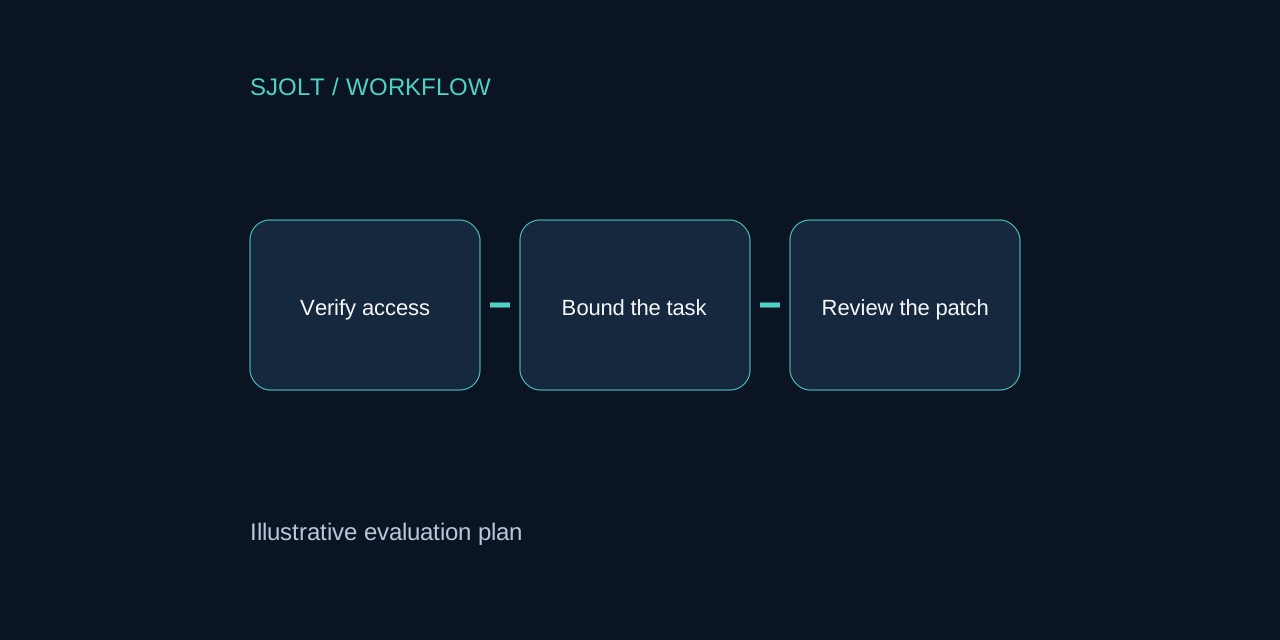
Claude Fable 5.2 is an announced Anthropic model. Start with its official access documentation, then test a difficult task with a clear stopping condition. SJolt now lists a reviewed native Messages route for Fable 5.2.
This guide addresses both “fable 5.2” and “claude fable 5.2.” It separates access checks from a proposed evaluation you can run on your own account. No paid request or performance benchmark was run for this article.
What is confirmed
Anthropic announced Fable 5.2 on November 9, 2026. It positions the model for complex technical work. The announcement distinguishes broadly available Fable from Mythos access through verification programs; the names should not be treated as interchangeable account entitlements.
The Claude API documentation identifies claude-fable-5-2, with a 1M-token context window, 128K maximum output and text/image inputs producing text. These are documented limits, not a guarantee that a single request can use every maximum simultaneously. Leave space for the response and follow the chosen endpoint’s current requirements.
Confirm the service before changing a request
- Choose the service where you will run the test and read its own model listing. A display name in an app is not necessarily an API identifier.
- Confirm that the account can select the model. Record the exact model ID, endpoint, region if applicable and access date.
- Save a copy of your working request before migrating. Change model-specific settings deliberately rather than copying a payload from another provider.
- Set an output allowance and an application timeout appropriate to a long task. Record any stop reason or incomplete answer before deciding to retry.
A failed request can reflect account access, a malformed payload, an unsupported parameter or service capacity. Preserve the status and a redacted error message. Repeating the same failing job with a larger budget does not distinguish those causes. A useful first check is a short, non-sensitive text task before enabling file access or tools.
For cloud-managed deployments, check that platform’s contract separately. Google Cloud publishes a Fable 5.2 model page; platform availability still does not establish entitlement for your project.
Use a migration task with a checkable answer
Our proposed first evaluation is a small dependency migration in a disposable copy of a repository. Choose a real change your team understands: replace one deprecated parser call while preserving behavior on empty input, escaped delimiters and malformed records. Provide only the relevant files and the existing test command. This produces a reviewable artifact and avoids turning the first trial into an open-ended rewrite.
Task: migrate one parser call without changing observable behavior.
Inputs: parser module, caller, existing tests, dependency migration note.
Constraints: keep public types and error messages stable; add no dependency.
Deliverable: patch, changed-behavior explanation, test results.
Stop when: tests pass and each acceptance case is accounted for.
If blocked: identify the missing source or conflicting requirement.
Before running, write down the expected outputs for the three edge cases yourself. Then inspect the patch independently. Passing tests matter only if they cover the failure you care about; a newly generated test that asserts the same mistaken assumption as the patch can still pass. Record whether the model requested missing information instead of fabricating an API.
Use a second task with a different failure mode, such as reconciling two conflicting release notes into a migration checklist. Require source locations for every required change. This tests whether a technically plausible explanation remains grounded when the input documents disagree.
Measure the finished deliverable
| Record | Why it changes the decision |
|---|---|
| Accepted result | A runnable patch matters more than the length of its explanation. |
| Human review minutes | A correct-looking patch that takes an hour to verify may miss the delivery goal. |
| Retries and tool actions | The full workflow can cost more than the final response. |
| Unresolved assumptions | Expose uncertainty before merging or using generated instructions. |
Keep the prompt, source revision and acceptance criteria fixed across attempts. Change one setting at a time. If the first result fails, classify the failure before adjusting the prompt: missing context, incorrect interpretation, implementation defect or incomplete verification. This makes the next trial informative rather than merely different.
Do not interpret vendor demonstrations as results on your codebase. A successful complex demonstration can motivate a trial; it does not tell you whether the model will preserve your specific compatibility requirement. Set a maximum number of attempts and stop when you reach it.
Where SJolt fits today
SJolt’s local catalog includes Claude Fable 5.2 and Claude Opus 5.5 through separate native Anthropic Messages routes. Use each model page for its public identifier and current request contract; the models are not aliases. This review checks repository support and does not verify a live account or deployment.
If the accepted text output becomes an image brief, review its subject, required copy and visual exclusions before handing it to a supported image workflow. Keep the reasoning result and generated asset as separate deliverables so a failed image does not trigger another expensive research run.
Sources & further reading
Take the next idea into production.
Explore the models, test a workflow in the playground, and use the same request in your application.